Phulchoki Hike from Godawari: Routes, Fare, Birds
Get Tours Team
Travel Writer
Phulchoki day hike from Godawari: routes & fares
Phulchoki Hike from Godawari: Routes, Time, Bus Fare and Birds
Quick answer: Phulchoki (also spelled Phulchowki) is a full-day hike from Godawari, on the south-eastern edge of the Kathmandu Valley, reaching about 2,750 m. Our hike in October 2026 took about 4 hours up and 1.5 to 2 hours down. Buses from Ratna Park via Lagankhel cost around Rs 50 per person. There are two routes: a long gentle road and a steeper trail.
By Prabesh Paudel, Operations Manager, GET Tours. Hiked on Saturday, October 3, 2026. Practical details last checked November 2026.
My girlfriend and I did this hike as a spontaneous day trip, took the wrong route for a while, were fed lunch by three strangers at the top, and came down with sore knees. This is the honest version, plus everything I checked afterward so you don’t have to.
How did our Phulchoki hike start?
We decided on Friday night. She arrived at my place around 7 a.m. on Saturday, I took the bike out, and we rode straight toward Godawari. On the way we stopped for breakfast: chickpeas, tea, and a samosa.
Three women at the next table were laughing, smoking, and chatting. When we said we were going up Phulchoki, they told us to ride the bike all the way, because the route is very long and easy to get lost on. We wanted to hike, so we parked at the bottom of the hill in Godawari, where there are many shops.
Bike parking cost Rs 10. We also paid a Rs 100 refundable deposit and received a card, which is there so hikers don’t leave food waste or wrappers on the trail. The starting point was busy: a birdwatching group with binoculars, kids, hiking teams, and one foreigner.
Why did we end up on the road instead of the hiking trail?
The first stretch was paved, with a river running beside it. The water was very white, and I never found out its name. Everything was clean and well kept. Birds were everywhere, the air was fresh, and the sky was cloudy like it might rain, though it never did.
We passed a signboard saying Phulchoki was 14 km away on the “full circuit”. Neither of us had been here before, so we didn’t realize the hiking trail and the road are different paths. We kept walking the road, which was wide, quiet, and gentle. Other people were using it, so we assumed we were on the right track.
The road was easy and peaceful: deep forest, lots of trees, mushrooms along the edges, and a family having a picnic with two small kids. The views were mostly blocked by trees, but we could be loud and silly because nobody was around.
Around the 9 km marker we met the group from the trailhead again. They had taken the real hiking trail and were resting ahead of us. I had already spotted the trail, but we’d stayed on the road because it was quieter. This time we joined them.
What is the Phulchoki hiking trail like compared to the road?
The trail was much steeper, with stairs, loose dirt, and bushes, and it didn’t look well maintained. We gained height fast. It was also crowded: a Mexican hiker, some Indian guys, and a group of school-age friends playing music with no teacher in sight. It was fun, but the peace of the road was gone.
I carried everything: two bottles of water, two samosas, a packet of Lay’s, and noodles. We sipped water carefully and kept breaks short, since we still had a lot of climbing left.
In one bushy section a leech got onto my leg (I was in shorts). I flicked it off, and that was the end of it.
After a while we reached the first real viewpoint. Other hikers were resting, the valley was below us, and fog was rolling in. We took photos and ate chips for about 5 to 7 minutes. Even then, the views stayed limited, mostly forest, roots, and walking. If you expect big panoramas the whole way, you may be disappointed.
How far is the summit when someone says “15 minutes”?
Further than they think. About three hours in, the trail mixed with a rough road that cars and motorbikes could use. We saw a car carrying three women going up for religious reasons, and some serious hikers who overtook us casually. We passed a lake with a board calling it Suryakunda. I’m not convinced it was the real one. It looked gloomy, like a horror-movie lake.
I asked a serious hiker how far the top was. “15 minutes,” he said. It took another 45. We saw birds, insects, and even a monkey, which surprised me. Then we reached a gate, and a man on a bike told us it was 100 meters away. That took a while too.
What is at the top of Phulchoki?
Near the gate there were shops, all closed. We didn’t stop and pushed on for a short climb past some Shivalingas to the summit. At the top there’s a network tower and an army post with barbed wire around a restricted area. The summit gets covered in cloud about every 15 minutes. At the army post we only wrote our name and the time.
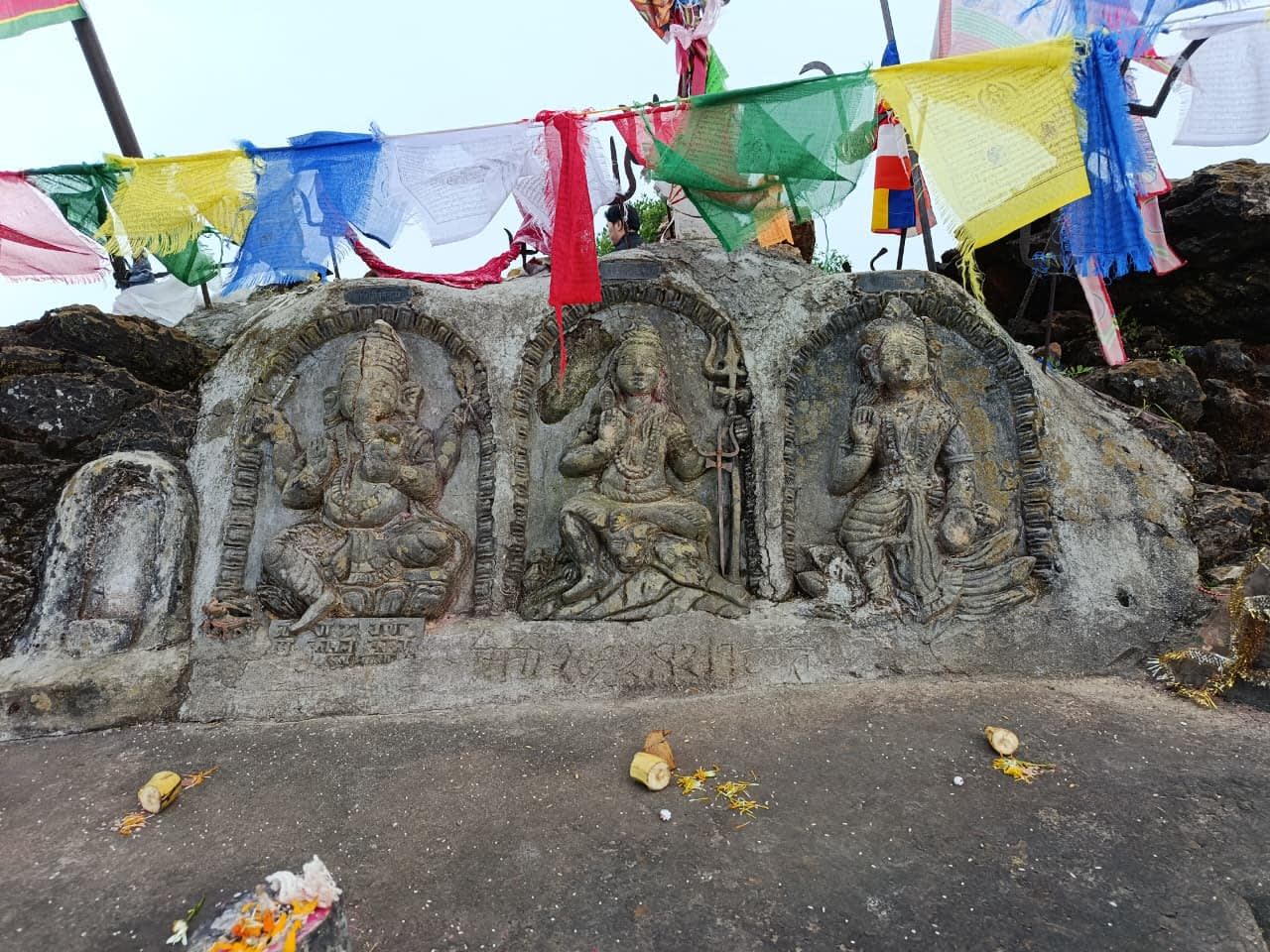
It was crowded, with people taking photos and celebrating. The three women we’d met at breakfast were there doing serious puja, and I also saw a goat being sacrificed as an offering. There were statues of Shiva, Ganesh, and Devi, a Buddhist chaitya, and a bell people were ringing. We took our shoes off and walked barefoot for a bit, which felt great.
Who fed us lunch on Phulchoki?
Back down at the shop area, the same three women were eating the lunch they’d brought. I was thirsty, they had Mountain Dew, and I asked nicely. They gave me a glass, and then they offered us their food too: beaten rice, cooked potatoes, soybeans, and pickles. My girlfriend is vegetarian, so we skipped the beans cooked with egg. There were no spoons, so we ate with our hands.
We never touched our own samosas. It was the best meal of the day, and it came from strangers.
Is the descent from Phulchoki harder than the climb?
For us, yes. We took the hiking trail down, and it was tougher than the climb. My knees hurt, the shortcuts were slippery, and one section dropped at almost 90 degrees. My girlfriend was taking her time there, and a group behind us rushed and one person fell. I asked them to wait and let people climb down first. Please don’t rush on that stretch.
At one point her tight shoes squeezed her toes badly. I gave her mine to wear, and we continued. Some trail sections made her nervous, so we took the road for parts, which was faster. We heard people cutting trees, but they were only dead ones.
The last long trail section was the part we’d skipped on the way up. It had stairs, uneven ground, even a dried waterfall, and trail markings showing we weren’t lost, though sometimes it felt that way. It took about 1 hour. At the bottom we were exhausted and got our Rs 100 deposit back. We still had to ride the bike home.
Phulchoki Hike: Quick Facts (Checked November 2026)
How do I get from Kathmandu to the Phulchoki trailhead?
The Phulchoki hike starts at the Godawari bus stop, roughly 15 to 18 km south-east of central Kathmandu. From Ratna Park, take a bus or minivan to Lagankhel (around Rs 25, 20 minutes), then a minivan to Godawari (around Rs 25, 30 minutes). In total that is around Rs 50 per person. Check fares on the day, as they can change.
Can I use Pathao, inDrive, or Yango to reach Godawari?
Yes. Pathao shows a fixed fare upfront, inDrive lets you propose your own price, and Yango launched in Kathmandu in 2025. A car from central Kathmandu to Godawari costs around Rs 1,300 on the apps, and bike rides cost roughly half the car rate. Prices change with demand, and you need a local phone number to use the apps.
How long does the Phulchoki hike take?
Our Phulchoki hike from Godawari took about 4 hours up and 1.5 to 2 hours down in early October 2026, including short rests. One tour operator estimates 4 to 5 hours to the summit, depending on fitness. Plan for a full day, start early, and carry water and food, since the shops near the top may be closed.
What are the two routes up Phulchoki?
The Phulchoki hike has two kinds of path: a wide road that winds up gently but takes longer, and a steeper hiking trail with stairs, roots, and shortcuts. We walked the road first without realizing, then switched to the trail. The trail gains height faster but is less maintained. You can mix both.
How hard is the Phulchoki hike?
Phulchoki is a moderate-to-demanding day hike for first-timers, not a casual walk. Published guides give roughly 8 to 10 km one way with about 1,400 m of climbing, while the trailhead signboard we saw said 14 km for the “full circuit”. The descent was harder than the climb for us because of knee strain and slippery shortcuts, so shoes with good grip matter.
How much does the Phulchoki hike cost?
At the Godawari trailhead we paid Rs 10 for bike parking and a Rs 100 refundable deposit, which we got back at the end. The deposit comes with a card meant to stop hikers from leaving food waste and wrappers. Bus travel to Godawari is around Rs 50 per person. At the army post near the top, we only wrote our names and the time.
What birds can I see on Phulchoki?
Phulchoki is one of the best birdwatching spots near Kathmandu. eBird’s checklist for Mt. Phulchowki lists more than 340 species. Commonly reported birds include Great Barbet, Maroon Oriole, Red-billed Blue-Magpie, Fire-tailed Sunbird, White-browed Shrike-Babbler, Small Niltava, Asian Barred Owlet, and Grey-headed Woodpecker. We saw many birds near the start but didn’t identify species.
What mushrooms grow in the Godawari and Phulchoki forest?
A 2011 survey from Godawari up to 2,250 m collected 45 macrofungi species and identified 20, including Agaricus silvicola, Amanita caesarea, Bovista plumbea, and Clavulina cristata. We saw many kinds of mushrooms on the road section. Do not pick or eat wild mushrooms here, because the Amanita genus includes deadly species.
When is the best time to hike Phulchoki?
Autumn (September to November) and spring (March to May) are the best seasons. A month-long festival is reported at the shrine in March and April. We went in early October, and it was cloudy, with valley views opening only in patches. We also met a leech, so check your legs after bushy sections.
What is at the top of Phulchoki?
The Phulchoki summit has a network tower, an army post with a restricted area, statues of Shiva, Ganesh, and Devi, a Buddhist chaitya, and a bell. Worship, including animal offerings, can take place there. The summit is often covered in cloud, and the shops near the top were closed when we arrived.
Is the Phulchoki hike safe?
Mostly, with care. Watch for slippery steep sections on the shortcut trail, leeches in bushy areas, and sudden fog. On the steepest drop, let people ahead of you climb down first. Carry enough water, wear shoes with grip, and don’t rely on distance estimates from other hikers. “15 minutes” turned into 45 for us.
Planning a hike or day trip around the Kathmandu Valley? GET Tours can help you plan it. Visit gettoursnepal.com or contact our team in Kathmandu.
Written by Prabesh Paudel, Operations Manager at GET Tours (Golden Era Travel and Tours Pvt. Ltd.), an NTB-registered tour operator based in Naya Bazar, Kathmandu.
Get Tours Team
Travel Writer & Nepal Explorer
Passionate about Nepal's trails, culture, and cuisine. Has trekked over 2,000km of Himalayan routes and written for leading travel publications.
Ready to explore?
Book Your Nepal Adventure
Let our local experts craft your perfect Nepal itinerary.
Browse ToursContact Us